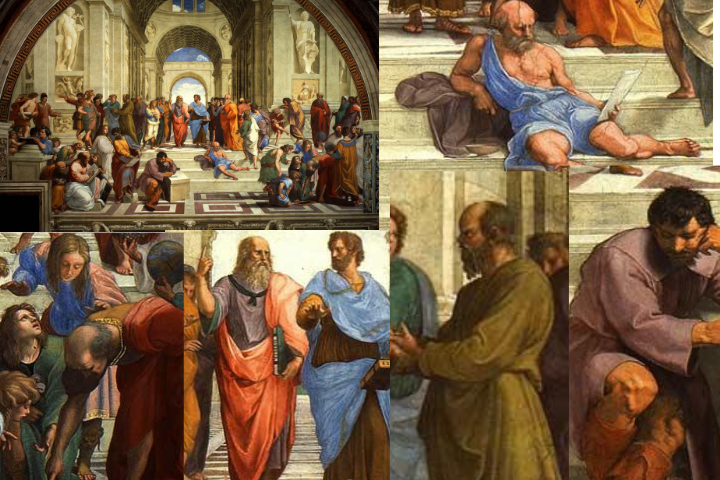
In part one, we looked at how Raphael's The School of Athens offers one of the richest roadmaps to understanding how people learn.
While the Renaissance master painted his fresco to depict great ancient thinkers, we can read each figure as a strategy of learning.
Of course, most of us learn in more than one way. Our own minds are The School of Athens in miniature, with some voices a little louder than others.
If we take the time to understand the lessons in learning that each philosopher can teach us, we can start to use our learning skills more effectively. And when we are in a position to lead, coach, and mentor others, having these approaches in mind helps us fit our method to the person we are teaching.
We can think of The School of Athens as a scene from our own lives. It's a boardroom meeting, a college class, a family dinner table. Throughout our lives, we keep encountering these same broad archetypes.

Back to School
We covered the central figures in part one (Plato, Aristotle, and Socrates). Here, we finish our survey with the many other characters. Part three then asks how the people in the fresco bring out the best in one another.
In the composition, they are placed either on the side of Plato or Aristotle, which can give us an impression of whether concepts (Plato) or active experience (Aristotle) are core features of these thinkers. We should remember, too, that real people rarely fit a neat dichotomy. Everyone contains many sides.
Pythagoras (570 to 495 BCE): Learn in a Group
Pythagoras was a philosopher working before the time of Socrates. He came up with many fascinating religious and political ideas.

While you might recognize the name today from the Pythagorean Theorem, this philosopher also led a community built around learning, teaching and a strict, largely vegetarian way of life. Ancient writers credit him, or his followers, with the idea that the Earth is a sphere and with many mathematical discoveries. According to tradition, he was also the first person to call himself a philosopher.
As we can see from the painting, he liked to be surrounded by other people, those he could teach and learn from. Just as he started a community of thinkers, many of us today thrive in a group learning environment.
It's as true today as it was in Raphael's time and in Ancient Greece: learning is a team sport.
Euclid (c. 325 to 265 BCE): Learn from First Principles
Euclid is credited with more or less creating geometry as we know it. Elements, his treatise on the subject, was used as a textbook for more than two thousand years. How did he make such an enduring mark on human thought? How did his theorems hold up and provide helpful knowledge for so long?

Euclid derived his major results from a few well-chosen axioms, bedrock ideas about how things worked. Because he kept the number small, he could make sure he picked the right ones. From there, he deduced and deduced and came up with a system that we still find helpful today.
Today we call this working from first principles. It's a powerful way to solve problems: peel back our assumptions and get down to the essence of what we can really say we know.
And like Pythagoras, Euclid is circled by students. One way to read the group is as a sequence of learning. The one closest to him looks down in awe, maybe a bit lost. The next one looks up, perhaps trying to integrate what he has just seen. The third stands up, his understanding beginning to blossom. The last one places a helpful hand on another pupil's shoulder, as if ready to explain it himself. As for Euclid, he keeps his head down over his work, barely aware of the world around him.
When we learn, we may play each of these students in turn until we become Euclid himself.
Ptolemy (c. 100 to 170 CE) and Zoroaster (pre-500 BCE): Learn with Stories
Ptolemy is one of the founding writers of Western astronomy. Zoroaster founded a religion in ancient Iran that went on to influence religious thinking for millennia.

Raphael places the two together (next to a possible self-portrait of the artist), one holding a globe of the stars and the other a globe of the earth. In the Renaissance, both were linked to the study of the heavens, to looking up at the sky to find patterns that provide some kind of meaning.
We can extend this idea to our ongoing search for meaning. One of the most powerful ways we pursue it is through storytelling, and that is our own reading of the scene.
Stories are one of the oldest ways humans have saved and handed down wisdom and information. They highlight what matters most and give us guides for how to act.
One of the best ways to learn is by creating a narrative arc. Where are we now? Where do we want to be? What is the problem we face? How do we overcome it? Put together, the answers to these questions tell a story.
Heraclitus (c. 535 to 475 BCE): Learn by Questioning Everything
Though very little direct evidence of his life exists, Heraclitus enjoys a vivid life in the writings of others. He thought about the unity of opposites, constant change and the human soul.

His work is, at times, hard to penetrate. That is why he has long been known as "The Obscure", quite the epithet for a writer. And yet, though only fragments of his work survive, he remains an important figure in the history of philosophy.
There is good reason for that. Heraclitus questioned everything, including received wisdom. This is one of the most important ways to learn. When we question our assumptions, the world becomes new again, and solutions that seemed impossible come within reach.
This approach is valuable for anyone who wants to come up with new ideas: we have to be willing to find and doubt our own assumptions.
Raphael painted Heraclitus alone, leaning on a block of marble in the foreground. Interestingly, the figure is missing from Raphael's preparatory cartoon in Milan, so it was added late, and many art historians see in it the features of Michelangelo. We come back to that in part three. Here, he can stand for the thinkers who take those lonely first steps away from "common sense" and into original thought.
Diogenes (c. 412 to 323 BCE): Learn Without Prejudice
Oh Diogenes, a famously entertaining philosopher! Tales of his exploits are the stuff of legend. In one (possibly apocryphal) story, he owned only a bowl because that's all he needed. When he saw a child drink water using his hands as a cup, Diogenes threw away his bowl.

He was a social critic, quick to confront the hypocrisy he saw in Athenian good manners. According to legend, he even made fun of Alexander the Great to his face. He lived in poverty, according to the virtues he argued for.
Many at the time were scandalized by his actions. He remains well known today because of his commitment to his ideals. And we can learn from him if we are willing to set aside our prejudices and listen. We rarely know who our next teacher will be, or what lesson we need to hear.
Young Student With Notepad: Grab a Pen
This unnamed student leans against the wall and props up his notepad on a leg. It seems a small detail, something you might skip over, but this image gives us a great idea for learning: grab a pen!

Imagine standing in this beautiful school filled with the great thinkers of ancient Greece. How could you capture all the wisdom and theories floating through the air? With a pen, of course. This student knows that writing things down as they come is how we hold on to what we encounter, and how we start to make it our own.
Learning Happens Everywhere
This next lesson zooms out to the setting of the painting. It's easy to miss, but notice how specific and realistic it seems. It might come as a surprise, then, that this grand hall is entirely imagined.
Let's take a lesson from this as well: learning happens in many places. It continues in hallways, on projects and over dinner, long after the classroom or training session ends.
As a leader, you can count on people learning wherever they are. Supporting that process means understanding the many ways and places they learn.
Raphael (1483 to 1520): Use What You Learn
As mentioned above, Raphael (whose birth name was Raffaello Sanzio da Urbino) likely placed himself in the painting next to the astronomers. This was a bold move. The artist had yet to make a name for himself, and while this would prove to be the masterpiece that confirmed him as a master, no one knew that yet.

Despite his youth, here he was, painting at the Vatican. He was tasked with creating an enormous fresco that would make a statement about the history of Western thought and the faculties of the human mind. He'd trained, practiced, and worked up to this point. He knew he was chosen for a reason. And when he was given the opportunity, he took it.
One of the most important parts of learning new skills is to actually use them. Or, as Harvard Business School professor Ananth Raman keeps reminding his students: "When your time comes, take the shot."
Raphael's example sums up the other lessons the painting gives us. The final piece of learning is the point where we go out into the world and act. And Raphael did one more thing with what he had learned: he passed it on to the people around him. That is the subject of part three.
The School of Athens series
Part 1: A Renaissance Guide for Coaches and Leaders
Part 2: Back to School (of Athens)
Part 3: Making Others Great: Raphael's View