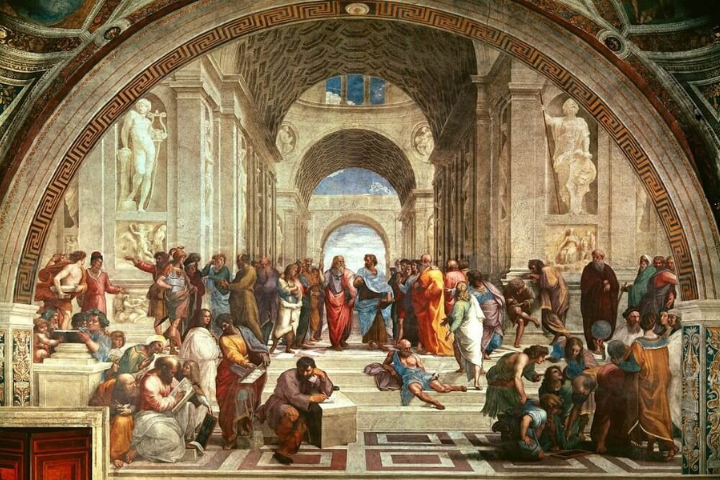
The School of Athens is an undisputed masterpiece by Italian High Renaissance artist Raffaello Sanzio da Urbino (1483-1520), better known as Raphael. It stands as an imposing fresco in the Stanza della Segnatura in the Papal Palace in Rome, its size matching the enormous scope of the work.

In the painting, great ancient thinkers are arranged in a grand tableau, standing in an architectural wonder that is rendered in a striking one-point perspective. The lush detail and compelling composition secured the young Raphael's place in the highest echelons of the Renaissance Masters, and the fresco remains a landmark achievement in art history.
Gathered under the statues of Apollo and Athena, the philosophers are all caught in a moment that evokes their beliefs, as well as their approach to thinking and their relationship (whether cordial or fraught) to one another. It is an entire course on ancient thought in a single painting.
As entrepreneurs, team leaders, coaches, professionals and human beings living in the 21st century, we might be skeptical that this painting can be relevant to us. But though Raphael completed the work in the early 16th century, and though it brings us a scene from two millennia before our time, taking in The School of Athens today gives us striking examples of how we might think and how we might ask our own questions of the world.
This is the first of three parts. Here we look at the three central figures. Part two covers the rest of the crowd, and part three asks how the people in the fresco bring out the best in one another.
Why the School of Athens Matters
If we look carefully, we see that The School of Athens provides us with a rich catalog of the many ways we learn about the world.
For us, it also shows the modern workplace, the modern community center, the modern home.
Learning how to learn, and how to teach others, has become essential.
The importance of learning has not protected it from confusion, unfortunately. Many educators still rely on ideas research has long questioned, like the idea that human learning comes down to the four simple styles (visual, auditory, reading and writing, and kinesthetic). What's more, easy online search has convinced many that a quick lookup can replace mastery of a subject, at least in a pinch.
Learning is far more individual than a four-mode model can describe, and it covers far more than accumulating knowledge.
This is critical. Most of us draw on several approaches, depending on the person, the subject and the situation. And learning itself is a process of gaining and changing knowledge, skills, habits, behaviors, or attitudes.
Did the young Raphael know all this when he traveled to the Vatican to begin sketching The School of Athens? Maybe, maybe not. His masterpiece nevertheless provides us with a roadmap to these insights. It turns abstract ideas into archetypal characters, and each of them stands for an approach to learning that we can practice ourselves and encourage in others.
That is art's power to teach us about learning.
Many of us assume that others learn the way we do. One look at the crowded scene in Raphael's painting suggests a richer picture.
Examined in detail, the fresco sends us back to our own lives ready to learn, teach and grow. In part one of this series, we'll start by looking at the three central characters.
The Philosophers in the Center of the World
In the center of the composition stand the two major figures of Ancient Greek philosophy: Plato and Aristotle. To the side stands Socrates, the one who started the tradition both these thinkers come from.

Plato points up to the world of forms, the essential patterns that he believed all reality stems from. Aristotle reaches out to the world of the viewer, as he preferred to observe reality before drawing his conclusions.
Their approaches differ, and they walk side by side. Plato taught Aristotle, and humanity has learned a great deal from both. Raphael places their difference at the center of the painting, and we can read it as a basic tension in how people learn: from ideas or from experience.
As an image, the pair also brings to mind the old question of nature and nurture. We are born with certain aptitudes and traits that form us. This element of nature, or Plato's world of forms, matters for our individual abilities. The experiences we have, both positive and negative, shape us just as profoundly. This element of nurture, closer to Aristotle's focus on the observable world, shows us the importance of what happens to us.
Few people are entirely like Plato or Aristotle. Most of us will recognize something of both in ourselves. And in the 21st century, we can still draw useful lessons from these central figures and the tension they represent.
Plato (c. 427 to 347 BCE): Learn from Concepts
Plato was a prolific writer in ancient Greece. His works include The Republic, where he laid down the foundations of political philosophy. Instead of writing treatises, he preferred writing theatrical dialogues between Socrates and other people. He is best known for his allegory of the cave that teaches us about the world of forms.
The world of forms is abstract, and many learners feel at home here. They gather information by reading or listening, taking notes and drawing their own conclusions. They can look at spreadsheets of data and see patterns. They can make use of concepts, applying them to the situation at hand.
This conceptual approach is great for coming up with new ways of doing things and sorting the information coming in. It turns data and resources into something we can act on. In that way, these learners can often be visionaries.
Aristotle (384 to 322 BCE): Learn from Hands-On Experience
Aristotle was a student of Plato. He went on to write a range of works that helped establish the basis of logic, ethics and science. He was also a talented mentor, taking a young Alexander the Great under his wing.
Learning by experience is the other great path of human learning. Practical, hands-on training helps everyone, and some people more than others. These are the people who prefer to start the board game right away and read the rules later.
This approach also protects us from the overreach of more abstract and conceptual thinking. There are times when leaders are so convinced by an idea that they ignore the evidence coming in, mistaking alarm bells for windchimes. An experience-based approach helps people adapt quickly.
Socrates (c. 470 to 399 BCE): Learn from Discussion
Socrates wrote nothing down (we know what he thought mainly thanks to his pupil Plato), but he said a lot. He is the namesake of the Socratic Method, where one uses discussion and debate to draw out the major ideas and finer points of one's thinking.

Many people learn through discussion: it helps them clarify what they think and discover points of view they had never considered. Taken to the extreme, it can make for a tiring dinner party guest. In groups, the ability to discuss ideas is especially helpful.
Friendly debate and deep discussion are among the best ways peers can teach each other. Mentors matter, and peers give us people to test new ideas and skills with. They also add a little competitive spark.
You might also notice that in his dialogues, Socrates asks far more questions than he gives answers. That's because learning is much more about asking than telling. A good question often does more for a learner than a good answer.
A World of Learning Approaches to Explore
In part two, we examine the other philosophers who make up the scene. Raphael's The School of Athens has many more insights to share about the ways people learn.
The three we've covered so far give us a great start. They show us the major themes that the other thinkers will take up, reconfigure, and make their own.
The School of Athens series
Part 1: A Renaissance Guide for Coaches and Leaders
Part 2: Back to School (of Athens)
Part 3: Making Others Great: Raphael's View